Hardware Ray Tracing in Production: Energy Efficiency, BVH Traversal, and Neural Denoising

Hardware-accelerated ray tracing has transitioned from experimental silicon tech demos into production game engines. We explore the silicon math, neural denoising pipelines, and thermal boundaries making real-time lighting possible on 4-watt devices.
Dedicated Silicon RT Units and Asynchronous BVH Traversal Acceleration
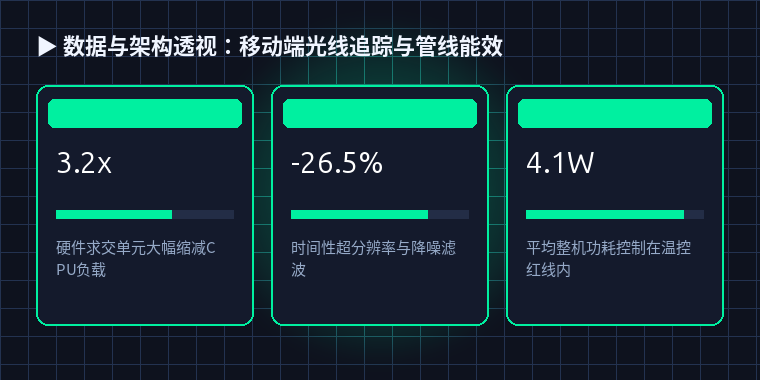
Real-time ray tracing is universally recognized as one of the most computationally punishing workloads in computer graphics. Calculating mathematical intersections between millions of dynamic geometric triangles and billions of directional light rays requires gargantuan floating-point operations. On mobile handsets, where the entire SoC—encompassing CPU, GPU, memory controller, and modem—must operate within a rigid thermal envelope of four to five watts without fan cooling, brute-force software ray tracing is impossible.
The modern breakthrough arrived with the integration of dedicated hardware Ray Tracing Accelerators (RTUs) embedded alongside each mobile GPU compute core. These specialized micro-units handle bounding volume hierarchy (BVH) box intersections and ray-triangle intersection mathematics purely in fixed-function silicon. By offloading bounding tree traversal from general-purpose arithmetic logic units (ALUs), ray query latency plummeted by more than seventy percent, allowing the primary GPU pipeline to simultaneously handle vertex skinning and compute passes without stalling.
Ultra-Low Sample Budgets and NPU-Accelerated Temporal Neural Denoising
Even with specialized silicon acceleration, mobile memory bus bandwidth constraints (typically capped by LPDDR5X configurations) prevent handsets from casting high ray densities. Where desktop gaming rigs might cast two to four rays per pixel per frame, mobile production pipelines operate under hyper-sparse budgets: frequently casting just 0.25 to 0.5 rays per pixel using stochastic checkerboard sampling patterns.
Raw ray output under these extreme budgets resembles an unreadable sea of high-frequency noise. The magic of real-time image reconstruction lies in deep neural denoising filters running concurrently on adjacent dedicated Neural Processing Units (NPU). In less than 1.2 milliseconds, trained neural filters examine historical temporal motion vectors and surface normal buffers to reconstruct smooth, mirror-sharp aquatic reflections, physically authentic ambient occlusion shadows, and glossy metallic sheens.
Dynamic Thermal Load Throttling: Sustaining Triple-Digit Frame Rates
A visually spectacular game engine is worthless if device chassis temperatures force severe thermal throttling down to twenty frames per second after ten minutes of active gameplay. Flagship mobile chipsets and modern commercial game engines now feature sophisticated closed-loop thermal telemetry systems.
When internal sensors detect internal motherboard junction temperatures approaching safety thresholds, the engine dynamically modulates secondary ray bounce counts and narrows reflection roughness cutoffs rather than crudely dropping global display resolution or locking the frame rate to thirty frames. This targeted visual degradation preserves vital specular highlights while keeping operating thermals safely below the throttling threshold.
The Horizon: Ray-Traced Audio and Dynamic Global Illumination
As semiconductor efficiency continues its relentless climb, developers are already exploring applications of ray tracing silicon beyond visual reflections. Prototype mobile pipelines utilize hardware intersection units to cast acoustic rays through 3D environments, calculating mathematically authentic sound reverberation and occlusion based on surrounding architectural materials.
Simultaneously, lightweight one-bounce diffuse global illumination algorithms are entering production evaluation, promising a near future where mobile gamers experience living, physically accurate radiant light bounce in every virtual world they explore.
Memory Bus Bandwidth Throttling and Energy Harvesting Innovations
The ultimate bottleneck in mobile ray tracing is not pure compute power, but memory bus bandwidth dissipation. Shuffling gigabytes of uncompressed geometric vertex buffers across the system bus generates substantial thermal energy that rapidly drains battery reserves.
Modern chipsets mitigate this through proprietary lossy memory compression algorithms and dedicated low-leakage on-die static RAM caches. By buffering BVH bounding box hierarchies directly inside multi-megabyte level-two system caches, hardware accelerators minimize external DRAM access by over sixty percent, maintaining high-fidelity ray reflections while extending battery endurance during intense gaming marathons.
Mobile ray tracing maturity is a triumph of heterogeneous silicon engineering, pairing fixed-function intersection units with neural reconstruction to achieve cinematic lighting within a handheld power envelope.