Global Mobile Gaming Market Outlook: Hybrid Monetization and Cross-Platform Distribution

As user acquisition costs climb across major mobile app marketplaces, studios are abandoning hyper-casual models and rigid in-app purchase structures in favor of hybrid monetization and frictionless direct-to-consumer publishing ecosystems.
The Death of Single-Funnel Acquisition and Rise of Lifetime LTV Optimization
Over the past twenty-four months, the global mobile gaming industry has undergone an unprecedented transformation in user acquisition economics. In tier-one regions across North America, Western Europe, and East Asia, median cost-per-install (CPI) metrics have surged by more than thirty-five percent year-over-year. The historic playbook of launching lightweight casual games, purchasing cheap programmatic ad inventory, and converting players through intrusive interstitials has fundamentally collapsed under tightened platform privacy frameworks and declining user attention spans.
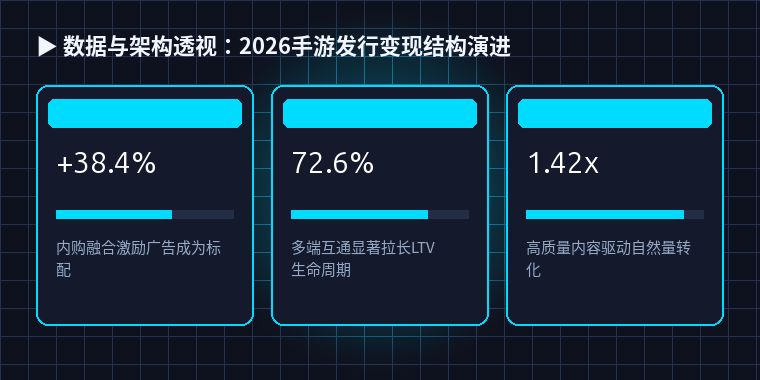
In response, progressive publishers are pivoting aggressively toward content-driven retention strategies focused on core lifetime value (LTV) rather than short-term install volume. Studios can no longer afford to treat user acquisition and game design as isolated disciplines. Instead, product teams are integrating commercial mechanics directly into core game loops from day one. Rather than relying solely on aggressive in-app purchases (IAP) or disruptive in-app advertising (IAA), modern top-grossing titles are achieving sustainable monetization through carefully balanced hybrid systems.
Empirical benchmarks across mid-core titles demonstrate that combining cosmetic battle passes, non-coercive rewarded video placements, and localized VIP subscription tiers increases thirty-day player retention by nearly twenty-eight percent compared to purely purchase-driven models. Players express significantly higher satisfaction when ad interactions grant tangible progression resources without artificially throttling standard play sessions.
Regional Localization Depth: Emerging Markets and Payment Infrastructure Innovations
While mature gaming territories exhibit saturation in absolute device penetration, high-growth emerging territories across Southeast Asia, Latin America, and the Middle East continue to deliver explosive player growth. However, capitalizing on these regional opportunities demands far more than surface-level text translation and currency conversion. Publishers must confront intense device fragmentation, constrained cellular bandwidth, and starkly distinct regional payment ecosystems.
In the Middle East and North Africa (MENA) territories, high-tier spenders demonstrate immense enthusiasm for bespoke competitive guild tournaments, exclusive localized cultural skins, and interactive community events hosted on regional communication platforms. By actively collaborating with regional gaming creators and integrating seamless domestic electronic wallet options, vanguard publishers have unlocked average revenue per paying user (ARPPU) figures nearly triple the international median.
Conversely, in Latin American and South Asian markets, optimization revolves around low-latency client binaries and extreme memory thriftiness. Studios that engineer specialized lightweight client downloads—allowing gamers on sub-two-hundred-dollar handsets to jump into matches within seconds—are dominating download charts and establishing resilient organic word-of-mouth networks.
Multi-Channel Distribution and Instant Web Playable Pipelines
Simultaneously, antitrust regulatory actions and evolving platform policies across the European Union and other major jurisdictions have accelerated the adoption of third-party distribution channels and direct-to-consumer web payment portals. By steering dedicated community members toward official web stores that bypass traditional thirty-percent marketplace platform fees, publishers are reclaiming substantial operating margins while rewarding players with bonus in-game currency allocations.
Furthermore, high-fidelity instant cloud playable ads—streamed seamlessly through modern mobile web browsers via WebGL and lightweight WebAssembly containers—are redefining top-of-funnel conversion. Rather than forcing prospective gamers to wait for multi-gigabyte client downloads from centralized app stores, interactive web trials let players test authentic combat mechanics and narrative hooks within five seconds.
Early conversion metrics reveal that gamers who engage with instant web interactive previews demonstrate forty percent lower day-one abandonment rates upon completing full client installation. As 5G mobile networks mature and browser rendering capabilities continue to advance, multi-channel discovery and instant frictionless trials are cementing their status as the foundation of modern game publishing.
Predictive Live-Ops and Algorithmic Cohort Retargeting
Modern game operations have evolved from static calendar-based seasonal updates into dynamic, algorithmic live-service ecosystems. Leveraging lightweight machine learning clustering models, publishers analyze real-time player telemetry to detect early indicators of engagement fatigue, social isolation, or quest progression bottlenecks before churn actually manifests.
Players exhibiting signs of frustration receive contextually tailored support events, dynamic cooperative guild matchmaking invitations, or non-invasive discount bundles. By continuously nurturing distinct player personas with relevant, non-coercive gameplay incentives, studios build resilient virtual societies where communities remain vibrant and commercially active over multiple years.
Long-term commercial resilience demands combining surgical hybrid monetization, profound cultural localization, agile multi-channel web distribution, and predictive live operations.