Deconstructing Chrono Edge: High-Speed ACT Combat and Touchscreen Input Revolution

Chrono Edge achieves what was long considered impossible: delivering frame-accurate parries, branching aerial combos, and blistering character action combat on a completely flat glass display.
Overcoming the Tactile Deficit: Gestural Combo Branching and Capacitive Dynamics
Action game purists have historically regarded touchscreen displays with justifiable skepticism. Traditional physical controllers provide tactile spring resistance, mechanical microswitch actuation clicks, and raised thumbstick boundaries that enable players to execute complex multi-button combos purely through muscle memory. On flat smartphone glass, the complete absence of physical landmarks has traditionally led to catastrophic mis-inputs, finger cramping, and clumsy on-screen button bloat.
Chrono Edge fundamentally shatters this paradigm by discarding legacy virtual controller layouts. Rather than cluttering the right half of the display with eight static miniature icons, the interface features two dynamic interactive zones that intelligently deform based on the user's natural thumb resting curvature. The primary attack zone utilizes fluid gesture vectors: tapping executes lightning-fast basic strikes, while micro-swiping diagonally upward, outward, or inward instantly branches into airborne launchers, gap-closing thrusts, or sweeping crowd-control sweeps.
Furthermore, the input engine measures capacitive touch surface expansion in real-time. By detecting the subtle spread of the thumb's contact patch, the software instantly distinguishes between rapid glancing jabs and deliberate heavy power charges, providing an astonishingly organic sense of weight and physical resistance without requiring physical buttons.
Temporal Stasis Mechanics and Sub-Frame Parrying Windows
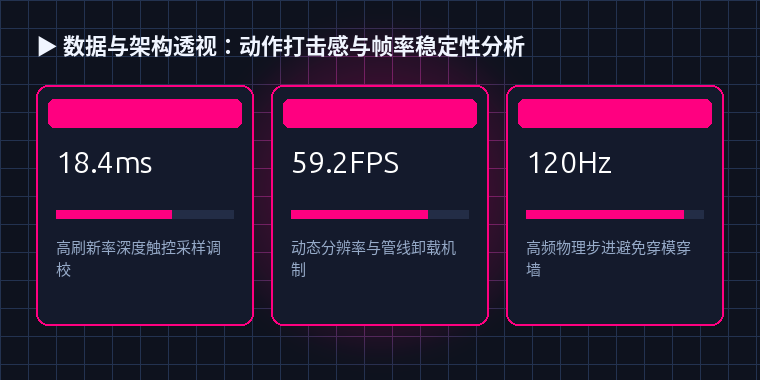
High-speed action titles live or die by the precision and fairness of their defensive mechanics. Chrono Edge introduces a signature combat mechanic dubbed the 'Chrono Stasis Fracture.' When an enemy strike lands within a razor-thin seventy-millisecond defensive window, the visual scene experiences a breathtaking chromatic inversion accompanied by local time dilation, freezing surrounding adversaries while granting the player three uninterrupted seconds to execute a devastating counter-sequence.
To prevent network packet jitter or frame pacing fluctuations from ruining this exhilarating mechanic during online cooperative encounters, the engineering team deployed a client-side predictive rollback architecture. Even when experiencing momentary cellular network degradation, the local simulation calculates defensive timing strictly against the player's immediate visual timeline, guaranteeing that a perfectly timed defensive reaction is never swallowed by latency.
Multisensory Audio-Haptic Synergy and Physical Impact Calibration
True combat visceral impact is a psychological synthesis of visual shockwaves, auditory resonance, and physical haptic sensations. Chrono Edge capitalizes on high-frequency linear resonant actuators (LRA) integrated within modern flagship devices to deliver bespoke haptic vibration profiles for every weapon archetype.
A high-frequency cybernetic katana slice produces a crisp, localized buzzing resonance that tapers off within twelve milliseconds, perfectly mimicking the acoustic slice of blade through carbon fiber. In contrast, swinging a colossal hydraulic warhammer triggers an intense, low-frequency thud that reverberates throughout the entire chassis of the device, synchronized with deep sub-bass acoustic rumbles.
This obsessive attention to multisensory feedback transforms the handheld device into an extension of the warrior's physical weapon, establishing a landmark standard for mobile action game choreography.
Boss Cadence Telegraphing and Visual Readability Architecture
Equally vital to tactile satisfaction is the visual clarity of hostile telegraphing animations. Because smartphone screens occupy a smaller field of vision than massive living-room televisions, enemy attack cues must be rendered with razor-sharp silhouette readability. High-threat boss abilities emit luminous holographic silhouette glints and directional audio cues two hundred milliseconds before the hitbox becomes active.
This deliberate telegraphed cadence transforms frantic boss encounters into exhilarating visual dances where players react instinctively to spatial cues, reinforcing the intoxicating sensation of absolute combat mastery under pressure while maintaining crystalline visual order amid neon-soaked explosions.
Adaptive Camera Framing and Dynamic Depth-of-Field in Touch ACT
A notoriously overlooked challenge in mobile character action titles is camera management during chaotic multi-target brawls. Without a physical right analog stick to manually manipulate perspective while simultaneously executing attack gestures, players can easily find themselves disoriented by blind spots.
Chrono Edge deploys an intelligent predictive virtual cinematographer that continuously evaluates player movement vectors, hostile threat radiuses, and dynamic environmental geometry. The camera smoothly widens its field of view during multi-enemy ambushes while dynamically pushing into an intimate, dramatic low-angle perspective during one-on-one boss duels, ensuring every acrobatic strike remains cinematic and legible.
Chrono Edge redefines mobile action choreography by proving that intuitive gestural vectors, rollback defensive buffers, bespoke linear haptics, and meticulous visual telegraphing can rival dedicated console combat controllers.